
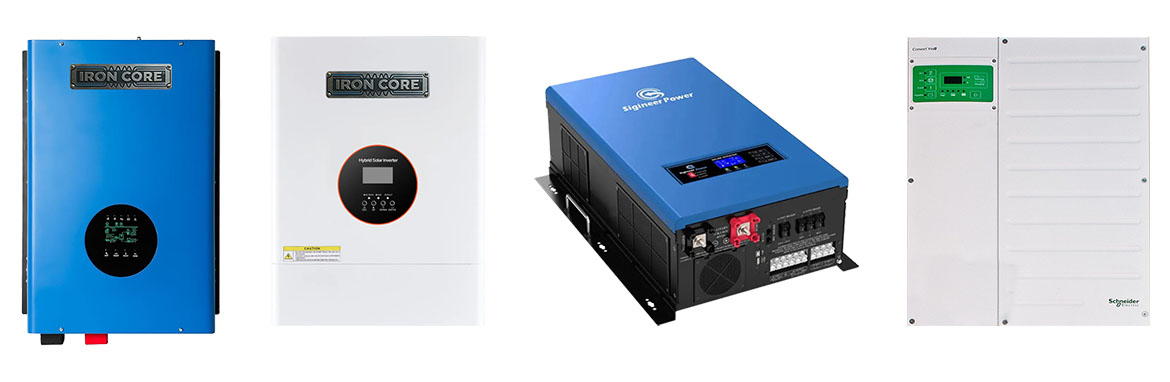
Heavy Duty, Low Frequency, Transformer Based Inverters
Low Frequency vs. High Frequency Inverters: Why Iron Core Transformer Technology Still Reigns Supreme
If you're shopping for an off-grid solar inverter, home battery backup system, or whole-house power solution, you'll quickly discover two very different inverter technologies on the market: low-frequency transformer-based inverters and high-frequency transformerless inverters.
While both technologies convert DC battery power into usable AC electricity, their design philosophies couldn't be more different.
Many consumers focus on power ratings, efficiency claims, and price tags while overlooking one of the most important factors affecting inverter performance, reliability, longevity, and safety: the transformer.
At DIYsolar.com, we've spent decades installing, testing, repairing, and evaluating inverter systems. Our experience has consistently demonstrated that when it comes to demanding off-grid and battery backup applications, low-frequency iron core transformer-based inverters remain the superior choice.
What Is a Low-Frequency Inverter?
A low-frequency inverter utilizes a large iron core transformer operating at standard utility frequencies, typically 50 Hz or 60 Hz.
This transformer serves several important functions:
- Voltage conversion
- Surge handling
- Electrical isolation
- Fault protection
- Power conditioning
Because these transformers contain substantial amounts of iron and copper, low-frequency inverters are typically much heavier than their high-frequency counterparts.
While some consumers view the extra weight as a disadvantage, experienced inverter technicians often view it as a sign of durability and capability.
What Is a High-Frequency Inverter?
High-frequency inverters eliminate the large iron core transformer in favor of lightweight electronic circuitry that switches at extremely high frequencies.
This design dramatically reduces:
- Weight
- Manufacturing costs
- Shipping costs
- Material costs
The result is a compact inverter that is easier and less expensive to manufacture.
However, these advantages often come with significant tradeoffs in surge capacity, durability, repairability, and long-term reliability.
Superior Surge Capacity
One of the biggest advantages of low-frequency inverter technology is its exceptional surge capability.
Many household loads require significantly more power during startup than during normal operation.
Examples include:
- Air conditioners
- Refrigerators
- Well pumps
- Air compressors
- Table saws
- Circular saws
- Power tools
- Electric motors
The large iron core transformer acts as an energy reservoir that can absorb and deliver massive surge currents for short periods.
As a result, a properly designed 10kW low-frequency inverter can often start loads that cause larger-rated high-frequency inverters to shut down or fault.
For off-grid homes and backup power systems, surge capability is often more important than the inverter's continuous power rating.
Greater Reliability Under Real-World Conditions
High-frequency inverter designs rely heavily on large numbers of MOSFETs, IGBTs, and high-speed switching circuits.
These components are subjected to:
- High temperatures
- High switching stresses
- Voltage spikes
- Harmonic distortion
- Reactive loads
Over time, these stresses can contribute to component failures.
Low-frequency inverter designs generally operate under lower switching stresses and distribute power through a robust transformer assembly that can tolerate demanding real-world operating conditions.
For applications requiring 24-hour operation, low-frequency designs have historically demonstrated excellent durability.
Galvanic Isolation Improves Safety
One of the most overlooked advantages of low-frequency transformer-based inverters is galvanic isolation.
The transformer physically separates the battery side of the system from the AC output side.
This separation provides several important benefits:
- Reduced risk of DC leakage reaching appliances
- Improved fault isolation
- Enhanced electrical safety
- Better protection for sensitive electronics
- Reduced potential for destructive fault propagation
In contrast, many transformerless designs have direct electrical pathways between portions of the DC and AC circuits, relying entirely on electronic protection systems to maintain isolation.
Better Performance with Inductive Loads
Most homes contain a large number of inductive loads.
These include:
- HVAC equipment
- Refrigerators
- Freezers
- Well pumps
- Air compressors
- Shop equipment
- Washing machines
Inductive loads create reactive power demands that can challenge inverter electronics.
The massive iron core transformer found in low-frequency designs helps stabilize these loads and provides a substantial buffer against sudden current demands.
This often results in:
- Smoother motor starts
- Fewer nuisance shutdowns
- Better voltage regulation
- Reduced stress on inverter electronics
Longer Service Life
When evaluating inverter costs, many consumers focus exclusively on initial purchase price.
A better approach is to consider lifetime ownership cost.
A lower-priced inverter that requires replacement every few years can ultimately cost far more than a premium inverter designed for decades of service.
The heavy-duty construction of low-frequency inverter systems often includes:
- Larger heat sinks
- Larger transformers
- More robust power components
- Conservative engineering margins
- Lower component stress levels
These characteristics frequently contribute to a longer operational lifespan.
Improved Lightning and Electrical Disturbance Tolerance
While no inverter is immune to lightning damage, the substantial transformer found in low-frequency designs often provides an additional layer of protection against certain transient events and electrical disturbances.
The transformer can help absorb and isolate some voltage spikes that might otherwise be transmitted directly through sensitive electronic components.
This characteristic has made transformer-based designs popular in remote and demanding off-grid environments where electrical disturbances are more common.
Why High-Frequency Inverters Became Popular
If low-frequency inverters offer so many advantages, why did manufacturers move toward high-frequency designs?
The answer is simple: cost and weight.
Iron and copper are expensive. Large transformers are expensive. Shipping heavy equipment is expensive.
By eliminating the transformer, manufacturers can:
- Reduce production costs
- Lower shipping expenses
- Increase profit margins
- Produce lighter products
While these benefits are attractive from a manufacturing standpoint, they do not necessarily improve long-term performance or durability for the end user.
The DIY Solar Perspective
At DIYsolar.com, we evaluate inverter technology based on real-world performance rather than marketing claims.
Our experience repairing, testing, and supporting inverter systems has consistently shown that low-frequency iron core transformer-based inverters remain the preferred choice for demanding applications where reliability matters.
When powering an entire home, running critical loads during a blackout, or supporting an off-grid lifestyle, performance under difficult conditions often matters far more than saving a few pounds of weight.
That's why we continue to favor heavy-duty low-frequency inverter technology paired with premium LFP battery storage systems.
Final Thoughts
High-frequency inverters have their place in certain applications where compact size and low weight are priorities.
However, when maximum surge capacity, long-term reliability, electrical isolation, durability, and real-world performance are the primary goals, low-frequency iron core transformer-based inverters remain the benchmark by which all other inverter technologies are measured.
For homeowners, businesses, and off-grid users seeking dependable power for years to come, the extra iron and copper inside a low-frequency inverter aren't outdated technology—they're often the reason the inverter is still operating long after lighter-weight alternatives have failed.